
Mission Control
For the 2019 Moog Hackathon at Georgia Tech I collaborated with Ryan Rose and Richard Savery to produce Mission Control. We were given a Moog Werkstatt to use, and 48 hours to carry it out.
The Werkstatt
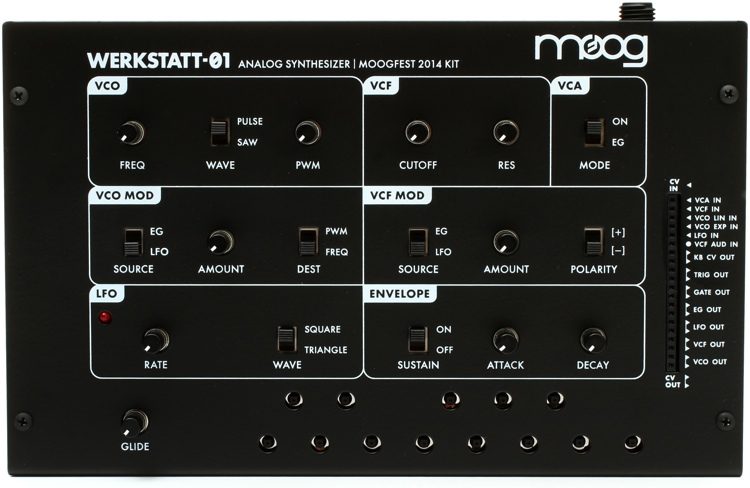
The Moog Werkstatt is a stripped-down modular synth designed for experimentation. It has 6 filters and some other controls, and a full octave keyboard.
All the schematics are available online, and it’s designed to be hacked – there are GPIO on the right, allowing external sensor output to be routed into the system. It can be used as it is, or can be extended and augmented by adding external control devices, or by hacking the internal PCB itself (the metal chassis is easily removed to allow access).
Design departure: NASA
I had been looking at pictures of NASA’s Apollo control rooms and was really taken by the interfaces people were using – complex, but uncomplicated, everything oversized by today’s standards and highly visible:
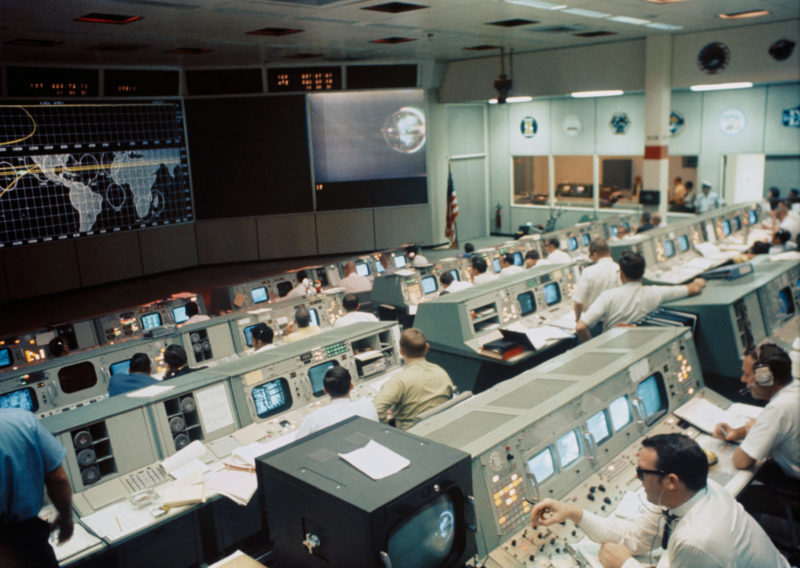
The size of the controls on these interfaces delighted me; one of my criticisms of modular systems is that they can be tiny and fiddly. I liked the notion of space to move, and being able to see and comprehend system state all at once, with no sub-menus or complicated series of button presses.
I also was inspired by spreading control among multiple people. Of course interfaces for control have changed, but this is still present at NASA: each person monitors and controls a small and specialised part of an enormously complex system, spreading the cognitive load among the group.
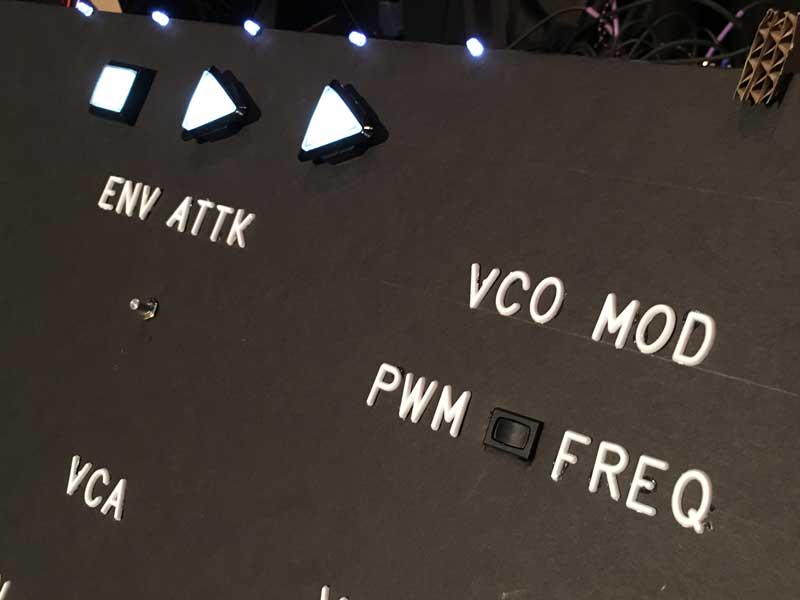
I saw a lot of parallels with musical performance, and therefore decided to take the Werkstatt’s controls and break them out into oversized interfaces. Since cardboard is cheap and easily laser cut – and because I will never get enough of high tech things being made out of paper – I had a material starting point, and a bag of arcade controls seemed like the ideal choice for making big buttons. I had some signage letters I had bought from Amazon, that I decided to use to label all the controls.
Distributed cognition and musical performance
I write a lot about constraint in my doctoral thesis, and is an important element in how I think about musical performance and design. Digital technology has given us near-infinite options on the size, scale, shape, materiality, and functions of musical instruments – more degrees of freedom than we can ever imagine. But, these degrees of freedom have not made us more creative, and instead there is evidence to suggest that it is not freedom that stimulates our creativity, but constraint.
A modular synth is a very complex system with lots of degrees of freedom. Even the Werkstatt, a very simple modular synth, has 18 controls over 6 filters, as well as a full octave keyboard. My collaborators and I had to decide how to distribute these – should each of us be in charge of a whole filter? Should someone control the keyboard, someone filtering, and the other something else?
We decided to invoke the spirit of John Cage and put all the controls in a hat (18 in total), and we each drew 6. These would be our main controls. We also drew 4 keyboard numbers. We would each have the tonic note, as well as our 4 additional notes.
Because each of us would have an incomplete set of controls and would not be able to see the controls of others, we would have to find ways of cooperating during the performance.
Electronic Implementation: Solder, solder, solder
In order to break out the controls, we had to solder what felt like everything in the entire world. My collaborators selected and soldered the leads onto switches and potentiometers, and I took on soldering the main board.
First I had to figure out how to remove all of the existing headers; the switches were pretty easy to break apart, but the potentiometers required desoldering and removing which was labour intensive. After that, I had to solder breakout wires. This was challenging because the heat required to desolder the components often damaged the existing pads, and I had to find ways to connect my wires to the signal traces. (Thank goodness for the online schematic.) I also soldered across each of the keyboard switches to break them out to the arcade buttons.
Physical build: Laser cutter and a lot of glue gunning
I had a pile of cardboard so I figured out the degree of pitch I wanted these interfaces to have (a little more than 45 degrees), and cut them on a laser cutter.
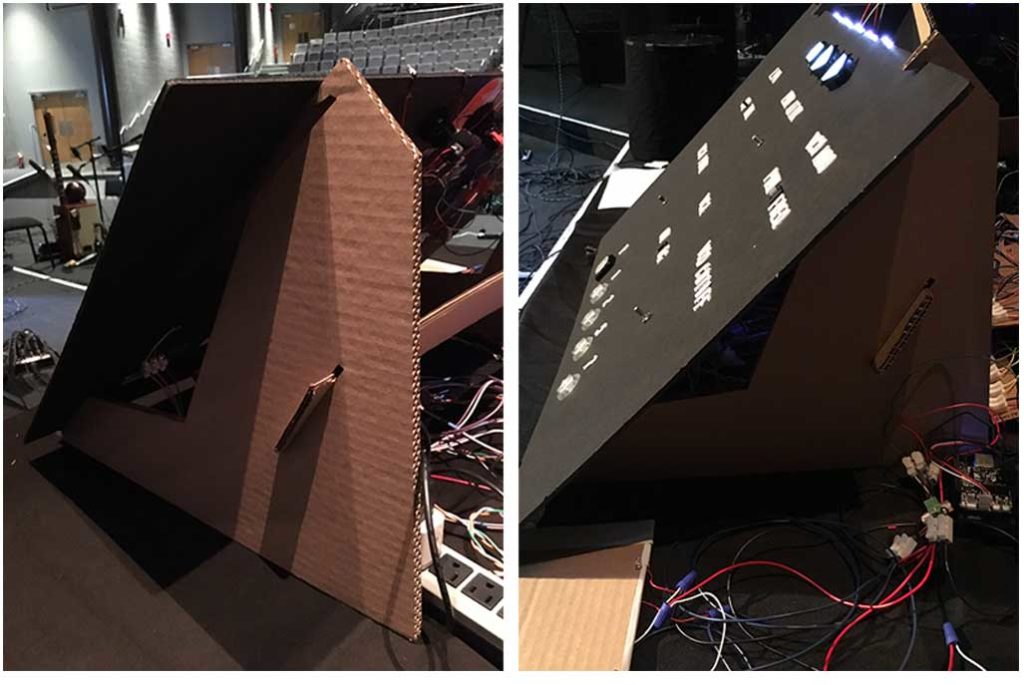
I then worked on setting all the controls into the interfaces. The key tool here was a foam core circle cutter that someone happened to have, which meant that cutting the circles for the buttons was far less labour intensive than it could have been! We chose three colours for the controls: mine was white, Ryan’s was blue, and Richard’s was red. I glued the letters above each of the controls so it was immediately obvious (to both performer and audience) what each one did.
We also placed LEDs at the top of each of the interfaces, that were driven by the output of the low frequency oscillator. This is one of the most important signals in a modular system, and a good way of all of us being able to tell what the system was doing. It also looked pretty cool!
We housed the hacked Werkstatt in the cardboard box that some of our components came in from Amazon.
Adding sampling and drum pads
We augmented this modular system with real-time sampling, in order to add some opportunity for percussive elements in live performance.
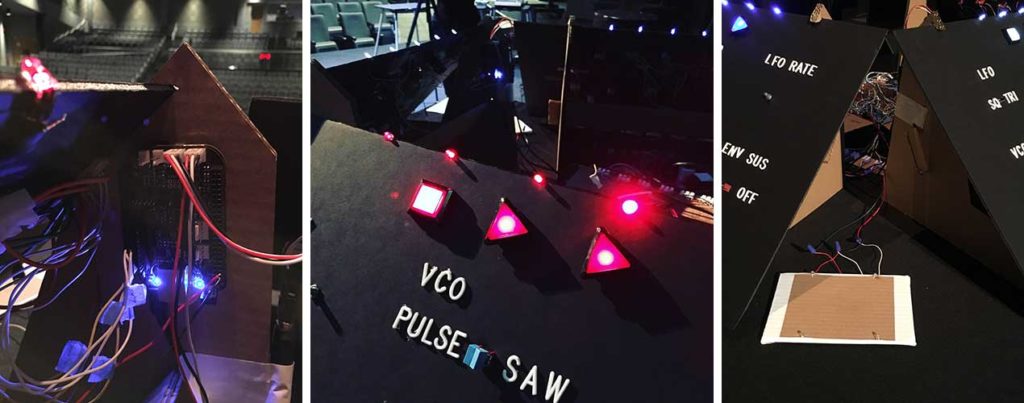
To do this, we added a Bela system to each interface. At the top of the interface is a square “record” button, and two triangular buttons that represented sample banks. Each Bela had the synth’s output going into its audio input.
By holding down the record button and then a sample button, we could create a sample by recording up to four seconds of live synth output, which we could reply by hitting the sample bank buttons. (This turned out to be one of the most exciting aspects of this instrument, as it’s very difficult to return to a previous state with a modular synth, especially one over which you don’t have total control. This meant that we could record something and then play it back later, referencing an earlier state. We could also use them as rhythmic triggers, which allowed us to add a percussive layer.)
We also constructed drum pads out of piezo elements and cardboard, inlaid with LEDs – one for each interface. When these were struck, the system would play back a percussion sample Richard made using the Werkstatt, meaning that there was also gestural percussion available to each performer.
Final presentation
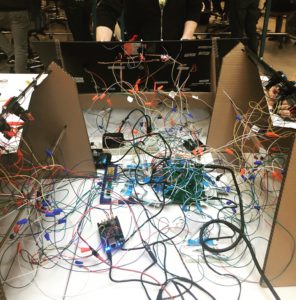
Hooking everything up was a challenge, and we ended up screwing all the wires together with solder nuts. The result was hideous enough to be worthy of a hackathon, but we plugged it in, threw the switch and … it worked.
We also ended up winning first place at the hackathon, and were invited to play Mission Control at the Guthman Musical Instrument Design Competition.
Outcomes
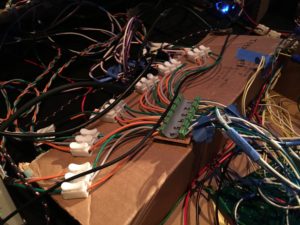
I spent some time re-engineering Mission Control, cleaning up the wiring and making it transportable (some little wire clips that I found on Amazon have since become my best friends). We kept a lot of the original elements though, from the cardboard housing to the original interface. The only things that have changed is that the system is stable.
Though Richard and Ryan didn’t continue with this project after the hackathon, I am continuing to play and compose with Mission Control (most recently appearing on a show on the Adult Swim network). I play with other musicians, and the effects of this design approach have been very illuminating.
Having an incomplete set of musical controls means that you become intimately acquainted with the nuance of each control you have. I have really dug into the potential of a VCO cutoff; it’s just one element of a VCO filter, but by having this control on my interface I’ve started to understand the possibilities of this single control.
This intimacy has illuminated an interesting direction for design thinking – distributed cognition did not reduce the creativity in performance, but instead it allowed us to think deeply and really learn the potential of each of these controls.