
Keppi
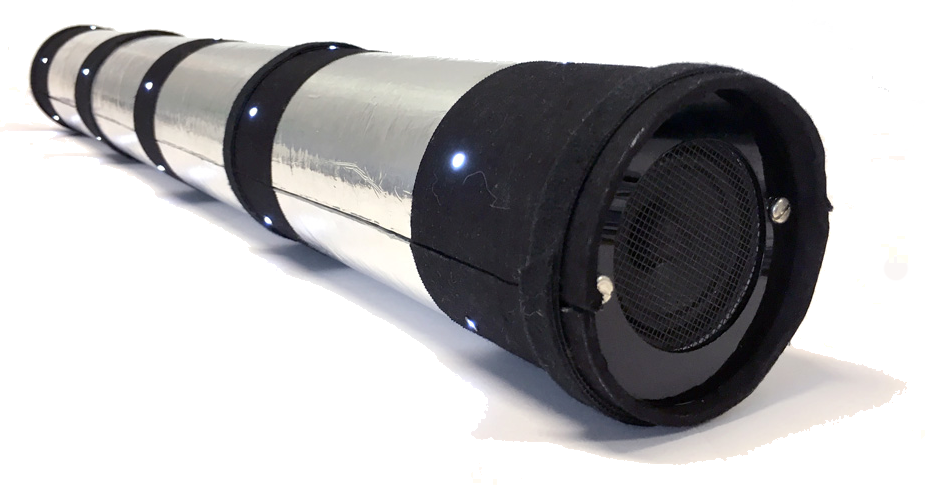
Keppi is an instrument I designed and produced for Study 3 of my PhD research. Study 3 explored the effect of disfluency on audience perception of DMI performance. Disfluency is defined as the experience of processing difficulty, and has been shown to result in heightened cognitive processing.
I wanted to design an instrument that would lend itself to being used in a risky way, and was interested in exploring how a percussion instrument could support this. Because of the physical nature of percussion I knew that the players would have excellent coordination and motor skills, so I decided to base the risk factor around them interacting with an instrument that was not a surface to hit, but an object that had to be struck.
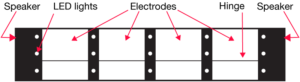
For this study I designed an instrument called Keppi, a percussion instrument in the form of a cylinder about 65cm long and 12cm in diameter. It has four large electrodes that wrap around the body of the instrument, interspersed with five rows of LED lights, and speakers embedded in either end of the cylinder. When the performer taps one of the four electrodes, the embedded computer receives a trigger via capacitive touch and triggers a sample, applying a velocity based on the signal generated by the piezo network underneath the electrode that was tapped.
I was interested in introducing disfluency into Keppi not as a design feature, but as a behaviour, and was interested in this disfluency being visible to the audience. Six Keppis were produced for this study and all were visually identical, but differed in one behavioural aspect: Some included an accelerometer, and the embedded system constantly monitored the quantity of movement of the instrument. If it was not sufficiently moved through space, the five rows of lights would begin to tick down, ticking up again if Keppi sensed enough movement through space. If not moved enough the lights would tick down, and when they went off Keppi would cease to make sound. \corrections{Moving Keppi charged the lights up again.}
I then produced six identical versions of Keppi, one for each of the performers. and each had one of three behaviour conditions, and a total of two of each behaviour type:
Control group: No disfluency. There was no requirement to move the instrument, and all lights stayed on at all times.
Condition 1: The instrument’s lights would tick down at the rate of 1500ms.
Condition 2: The instrument’s lights would tick down at the rate of 650ms.
The percussionists
For this study I focused on recruiting percussionists with five or more years of training and performance experience, to ensure that all percussionists would be sufficiently skilled and no performance could be dismissed out of hand simply because the performer wasn’t very good.
I was fortunate to be introduced to a network of percussionists who were alumni of the Guildhall music program. Four of the participants were from this network. The other two were percussionists with the appropriate level of skill and experience recruited from elsewhere. None of these percussionists usually played DMIs such as MOAI.
Physical design
Keppi is a tube that is 62cm long and 12cm in diameter. The electrodes begin 12cm from each end and are approximately 7cm wide, with the borders between them approximately 2.5cm wide.
Since Keppi is entirely wireless to encourage movement in three dimensions, it is split in two halves and held closed with velcro strips that wrap around the ends, and the second and fourth row of LEDs. Since this velcro is narrow, black and has a low profile, it blends in with the rows of LEDs. Using velcro closes Keppi securely, but also allows it to be easily opened and closed for turning it on and off or to adjust the components inside if needed.
Considering the player’s body and incorporating curve were important aspects of MOAI, and these aspects influenced the physical design of Keppi. Keppi’s particular physical dimensions are a result of my desire to make something big enough that would encourage the player to consider their body in relation to it, and not appear to be a tool or toy. I also wanted the instrument to be visible to the audience from the stage. I chose a tube because I wanted Keppi to lend itself to be gripped with a hand, but I chose a wider tube to make it less of a baton and more of a cylinder.
LED lights
The LED lights were an essential and carefully-considered design element. Because of the audience-focused nature of this work, I wanted to build in a visual aspect that meant the audience would be aware of the time element of the disfluent behaviour.
The LEDs used were 3mm, and there were 6 in each of the 5 rows. The lights in each row were equally spaced around the outside of the instrument. This was to ensure that the lights would be visible at every angle, but would not act as a single band of lights (which I was concerned would resemble a thermometer or some other kind of sensor technology).
Consideration of affordances
The ways that a DMI’s form factor can act as an affordance is a particular interest of mine, and I was therefore interested in creating a DMI that was not immediately conducive to being placed on a table. I wanted Keppi to be something that encouraged physical interaction, and therefore made it something that was meant to be held.
The design of the percussion input further encouraged this. In order to produce a sound the performer must tap, slap, hit, or otherwise produce a strike on one of the four electrodes. Because the percussive surface doesn’t sit on a horizontal surface like the skin of a drum, this presents a range of other interactive options: The instrument might be dropped into the hands, thrown and caught, tossed from hand to hand, held with one hand and tapped with the other, and so on.
The performer also does not have to use their hands. The embedded system recognises a touch when in contact with a conductive surface, which might be any part of the skin.
Again, constraint was applied to the affordances of Keppi. The sound palette was limited, and there was no way to produce sound other than by striking it with a part of the body.
Material considerations
The housing of Keppi is made out of a cardboard poster tube. This presented the advantage of being sturdy yet lightweight, and was a workable size that was not so big that it was hard to grip, or so small that it was fiddly to handle.
The outer materials were selected based on functionality and visual appearance. The electrodes were made with conductive tape which is shiny and reflective, and I wanted to contrast this with a matte material for the spaces between the electrodes that held the lights.
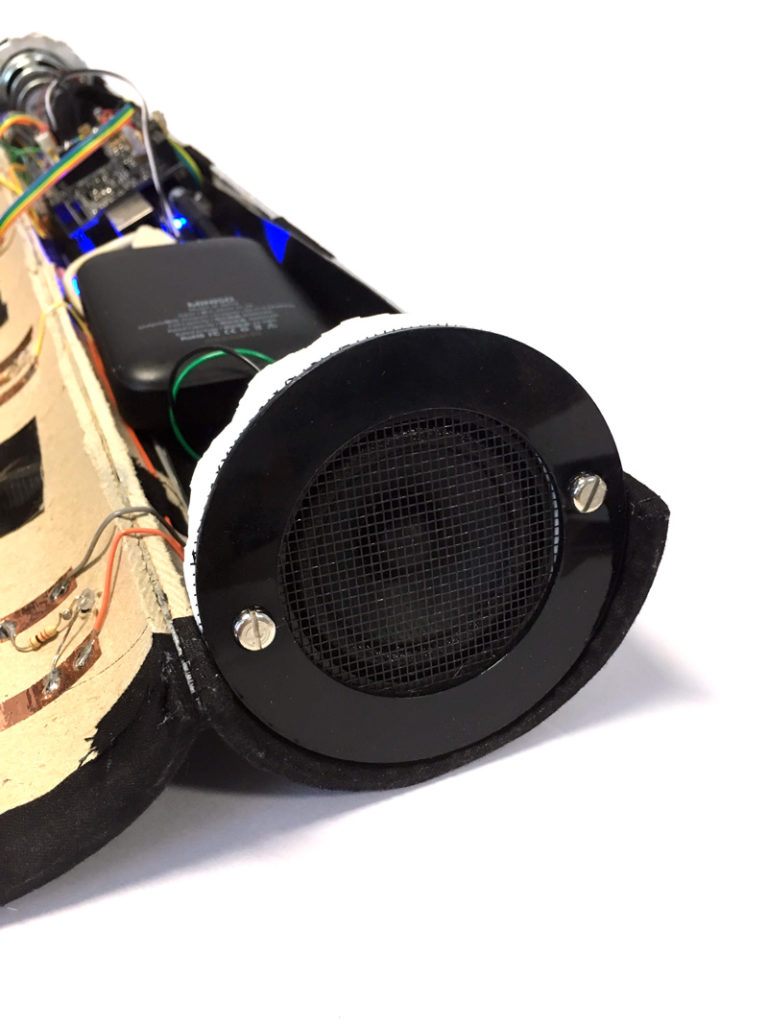
The speakers in the ends of the instrument were held in place by mounts made from the original plastic plugs of the poster tubes and cutting out a space for the speaker in the middle. Using the original plugs meant that the housing was exactly the exact right size. I further reinforced these with an acrylic ring that attached to the speaker and mount with screws, and was covered with plastic mesh to give it a finished look (see Figure \ref{fig:IN_keppi_speaker}).
The tape that formed the separation between the electrodes, and through which the LEDs shone, was athletic tape for sprained joints. This tape is extremely thin, extremely adhesive, is entirely matte and is textured to the touch, making it hard-wearing, easy to grip, and with a low profile to avoid a ridge on the instrument that might get in the way of playing.
Electronics
The round housing of Keppi required a rethinking of how the internal electronics would be built. All connections terminated at a breadboard to ensure a firm connection, and cables in turn connected these inputs to a central Bela unit that does all sensor processing and produces sound output.
In order to minimise the number of wires on the inside of the instrument I adopted a cut-and-paste approach to assembly using copper tape. First, I mounted the LEDs in holes drilled in the tube housing, and then soldered the legs to a strip of copper tape (first attaching 220Ω resistors to one leg). Each half of the tube had 3 LEDs of the 6 LED group, and the halves were joined with a jumper wire that went over the hinge.
Each ring of LEDs operated from a single digital pin. Ground was supplied to each strip of LED anodes, and a 5-way cable connected the 5 strips to the breadboard, where they were then attached to 5 of Bela’s digital pins.
There was a network of 4 piezos underneath each electrode. These were 15mm piezos soldered together into two networked pairs. The two halves of the piezo networks were connected over the hinge, and a group of 4 collector wires connected all 4 networks to the resistor ladder on the breadboard. which led to a cable that attached to the Bela unit’s analogue inputs 0-5.
The capacitive touch was handled using an MPR121 board. The electrodes on the outside of the tube were each made of one large piece of conductive aluminum tape wrapped around the tube and folded over the edge where the instrument opened. This overhang was where the electrodes connected to the MPR121.
In the instruments that had a disfluent behaviour an accelerometer was also used. This was attached to the underside of the breadboard.
Programming and sensor processing
The code for Keppi is publicly available on Github.
I employed a design strategy where I separate sound triggering from the velocity sensing. This separation was advantageous because, while both the onset of the strike and its velocity are sensed by a piezo, but Keppi had four piezo networks, one under each electrode, and there was significant cross talk between them when the instrument was struck. To mitigate this, the signal from piezo networks under the electrodes were continuously sampled by the Bela system, but this data was only used if the system detected skin contact on a given electrode via capacitive touch.
Motion was sensed via an accelerometer, which processed the data from the X, Y and Z axes. A 2nd order low pass filter to reject the high frequency motion that would be caused by each strike.
Quantity of motion was used to control the lights. First, the square of the difference in motion for this sample was calculated, then quantity of motion was found by determining Euclidan distance. If quantity of motion decreased over time, the lights would tick down. If it increased, the lights would tick up.
Interaction and sound design
The sound for Keppi was generated with the Chromaphone 2 plugin for Logic. This library allows for percussion synthesis by specifying various real-world parameters (mainly the shape and material of the surface, and various subtle adjustments therein).
In order to connect Keppi’s sound to its appearance I synthesised a sound using the parameters for a rigid, hollow, and resonant pipe, adjusting until I felt it matched the physical design. I exported a core tone, and then transposed it to produce the family of four sounds (one per electrode).
Reflections
I was satisfied with the outcome of Keppi. There were some technical problems during the performance, but as an instrument I feel Keppi was successful for the study and remains compelling to play.
Interactive pluralism was a design value that again was applied to this design process, and I considered carefully what the important aspects of percussion were, and how I could preserve these but bring them into a new context. For Keppi, I wanted to retain this straightforward cause and effect relationship that is characteristic of percussion, but change it slightly so the player had to negotiate a three dimensional object and not a static surface.
The evidence that Keppi achieved interactive pluralism is in the performances of the study. The six performers who participated in Study 3 each developed a diversity of ways of playing the instrument, and their existing styles of playing were evident. Keppi was played standing, sitting, rhythms were added with stomping, it was played with hands, fingers, knees, feet.
Constraint was used in the physical design of Keppi. I didn’t want it to reference other percussion instruments but at the same time wanted the interaction to be clear, so I kept the action-to-sound relationship extremely straightforward. The sound palette was very limited which I think supported the clarity of action-to-sound, and the resonant tube sound suited the form factor of the instrument and also was true to the overall functionalist approach (but I would like to explore sounds where the pitch quality is less salient). The materials used — conductive tape and athletic tape — kept the visual information limited but provided clean lines and did not clutter the object with features.
Keppi had some interesting unexpected features. Though I had spent a lot of time playing it during the design process, I had not understood its visual potential until I saw others play it on stage. Keppi’s appearance is understated, but quite beautiful, and by limiting the features, paying attention to the surface, and carefully considering the number and placement of the LEDs the result is intriguing but believable as an instrument, as opposed to an experimental device or toy. Keppi’s stage presence is more than the sum of a poster tube, athletic tape, and aluminium foil.
Because of the visual aspect of Keppi, and because I have proved that they can be produced in multiples, I am interested in exploring Keppi’s ensemble potential. I would very much like to collaborate with other percussionists to compose and perform percussive pieces that would take advantage of the visibility of the tick-down behaviour, and explore a range of musical styles in which to use Keppi.
The challenge that remains is a technical one. Keppi’s speakers simply aren’t loud enough in their current form, so I need to come up with a way of transmitting the sound output to a PA, or exploring other ways of creating the sound. This is a considerable challenge as part of Keppi’s success with players was that it is entirely wireless and self-contained. Additionally, there are some subtle aspects of the capacitive sensing that still need to be resolved to make it reliably responsive. However, when these technical problems are solved in the next iteration, I feel Keppi will have real potential as an instrument for percussion performance.